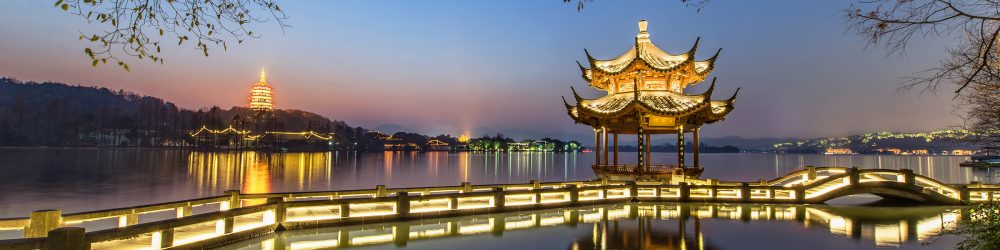
Months have passed since I last made a post here and so in an effort to be more proactive, I have here not just one trip summary, but two! Both featuring the Chinese word Jing in it. Which basically stands for Capital City, probably because both Nanjing and Beijing have at different times in Chinese history been the capital of China, well one currently is. Although the title of capital of the Chinese Empire has shifted a few times across the roughly 2,000 years of Dynastic China, these two are the most recent.
Both trips were made with very little time as we are now in the part of the school year wherein there are no significant breaks. All we have to survive on between this long 4 month stretch that is March – June are a few long weekends here and there. We used this longest of long weekends (Thursday + Friday off) to travel to Beijing. I had originally envisioned travelling to Beijing in the summer of 2019. However that was deemed one trip too many + the logistics of how far Beijing was from the more linear route we plowed over the summer. That trip had benefitted from being basically a straight line from Nanjing, to Luoyang and from Luoyang to Xi’an before taking a flight all the way back to Shanghai, effectively driving from the middle east coast of China to roughly the center to the West. Beijing is considerably further north and would have required an extra day of travel by train or plane each way. So we put it off until the following Summer break. Then Covid happened, so we stuck to just going to cities where the pandemic was not having sporadic outbreaks. Then we meant to go in October and Hector required more attention. Third time is the charm then as we finally made it to Beijing in late March.
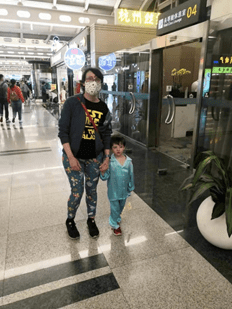
Leaving Wednesday night was perhaps a bit too adventurous as I had booked a flight the same day we work. Unfortunately, the flight was delayed for 2 and a half hours, making it a very-very late flight. Making matters worse, we stopped inexplicably in a tiny airport for a 30-minute break. Hector also had a toilet accident right after the suitcase with all of his other changes of pants was checked in. So I had to buy him a night set of silky-blue pajamas. At least he was able to relax in comfort.
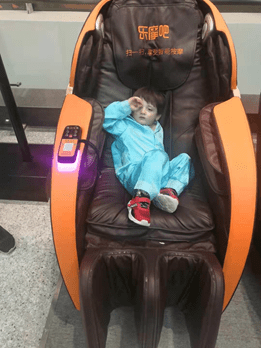
After checking into our hotel. At about…3:00am, we proceeded to pass out and wake the next morning to tackle the Forbidden City!
I took a few photos here, but not much beyond Hector running around like a maniac as he is want to do in such settings. This is largely because I prefer to buy glossy souvenir books which feature much more professional and nicer looking photos than anything I could take on my phone. That said here are some images of Hector frolicking.
After checking into our hotel. At about…3:00am, we proceeded to pass out and wake the next morning to tackle the Forbidden City!
I took a few photos here, but not much beyond Hector running around like a maniac as he is want to do in such settings. This is largely because I prefer to buy glossy souvenir books which feature much more professional and nicer looking photos than anything I could take on my phone. That said here are some images of Hector frolicking.
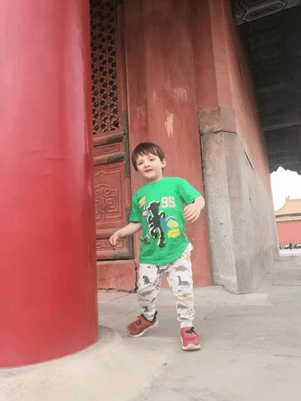
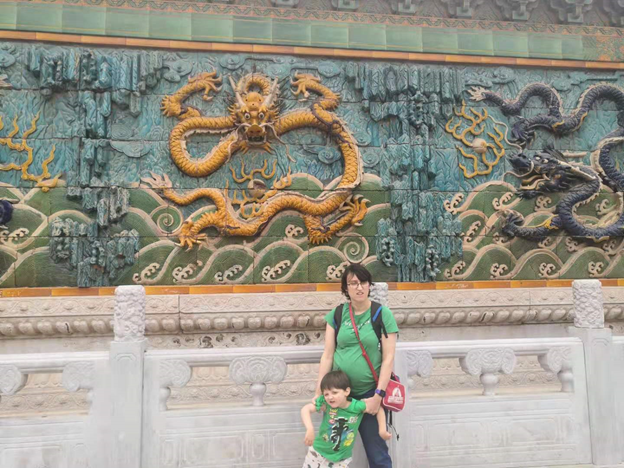
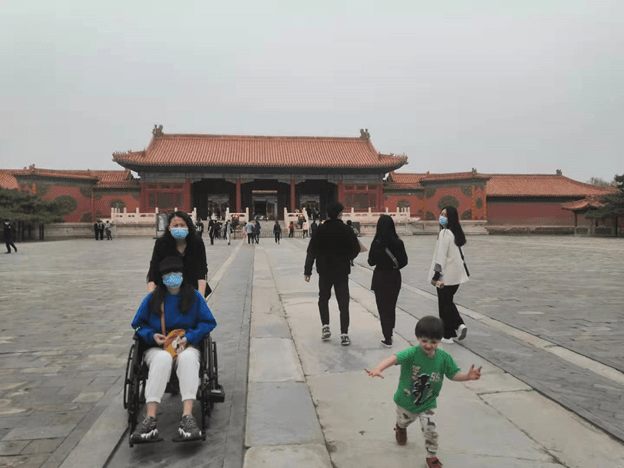
The Forbidden City was from the 15th to early 20th century the seat of Chinese Imperial Power, being the enormous living quarters for the Emperor, the Empress their children and the Emperors many many many Concubines. Although just one of the several royal complexes constructed by and for the Ming and later Qing Emperors, this one is perhaps the most famous. It is also in the best condition. The great big court yards have proven useful for the various regimes to occupy it, the orange/yellow tiled roofs of the many halls and palaces provide an epic backdrop if you are say an Invading British army, or French Army, or Japanese Army, or Nationalist Army, or a War Lord or the Communist Party. So yeah it has remained largely unharmed whereas many major Chinese constructions have been torched, bombed, or damaged. That said most of the halls cannot be entered and/or are very poorly lit. This is a bit of a downer as it means you mostly just get to walk around looking at impressive exteriors and missing out on what may be behind the closed doors, or at best squinting into a dark hall, just barely able to make out the glinting of gilded thrones. A few halls have been converted into impressive galleries and museums however, and in a sense the entire complex is one giant museum. After wandering around the grounds we made our way up to the top of what was once the Emperors back garden. Today a highway severs it from direct connection to the rest of the palace grounds. However the views from atop of the hill are great, you can really get a good sense of the ‘heavenly geometry’ of the Forbidden City from up there.

Or just catch your breath.
Later that evening we went to one of Beijings more famous Roast Duck restaurants, or as it is known in the United Kingdom Peking Duck (That is to say Beijing duck). The restaurant was a towering thing, 6 floors of duck carving dining rooms, and this was just one of 5 locations throughout the city. The service was quick and an effort was made to be a bit showy about it all. The chef came out with a mobile carving station and sliced up an entire roast duck before the three of us, well…two really. Hector had swiftly passed out.

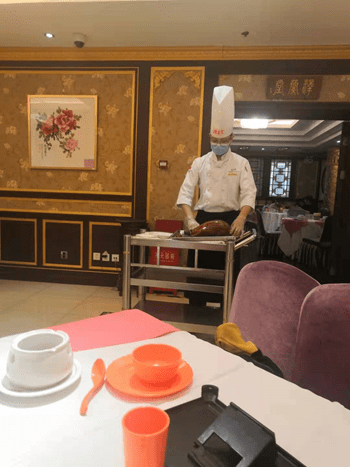
Mind you Hector passing out has become something of an ongoing joke with these trips we take. The following day he would do the same at another time honored Chinese Tourism destination. The Great Wall of China.

Pictured here Hector planking next to a communication cannon along the Great Wall.
We visited the Mutianyu section of the Great wall for two primary reasons. 1: It’s about an hour from Beijing city center. 2: It’s just about the walliest wall part of the wall. That is to say, one of the better maintained ones that looks a lot like what you think of when you think of the Great Wall.

The Mutianyu portion of the wall has crenulations on either side and a guard tower every 100 meters. On top of that it’s straddling a mountain range. So it really captures what a lot of foreigners think of when they think of the Great Wall of China. Other sections of the wall may be on flatter terrain or in different states of decay/over growth. The reality is that the thousands of miles of wall which make up the main stretch of the Great Wall of China are largely nothing like the post cards. Those more run down parts of the wall may be more authentic, but I figured if we were only going to see one part of the wall it might as well be one of the wallier-wall parts.

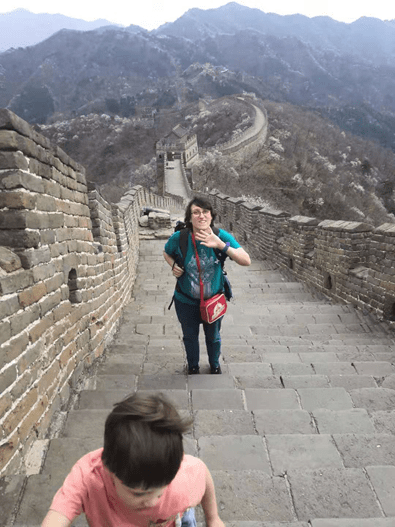
It should also be noted that this part of the Great Wall of China is particularly popular with and mostly visited by foreigners as it has in the last 20 years become the mandatory place all packaged tours bring non-Chinese to. It certainly shows with the Burger King at the base of the wall. However since there are nearly no outsiders visiting now, we got to enjoy a rare sight, a mostly empty wall!
Now the downside of all this travelling around Beijing had to be the traffic. We had heard how infamous Beijing traffic was and it certainly did not disappoint! We ended up getting back from the Mutianyu Wall section in the afternoon and proceeded to visit a very large and impressive foreign language book store.

Admittedly they were not very creative when naming this store.
We spent about an hour here picking up books for Hector, something he’s really gotten into recently, and I was able to pick up 8 or so books on Chinese History and culture. I am always on the hunt for more English language texts on Chinese History. In China you often find Chinese books which have been translated into English and then only sold in China alongside the original Chinese variant. This results in the strange situation wherein you can find more books on Chinese history in English, in China. Every reputable museum/tourist attraction likes to have sitting next to their souvenir book, an English variant, which seems to most of the time just collect dust. This does however mean that I am beginning to develop quite the library of Chinese books in English! That evening we visited the Cheesecake Factory. An American franchise dedicated to making very large portion sizes, there are not many locations in China at all, only 3 as far as I’m aware.
The third day is not worth speaking of…things went poorly logistically. I got lost in the National Museum of China (It’s actually a fusion of three pre-existing buildings and has 78 different exhibitions. We then got lost trying to get to the Summer Palace of the Qing Emperors. Upon arrival we learnt that I really should have reserved entry earlier. So we just walked around Tianamen Square for a bit and then went home in defeat to eat disgusting Dominoes pizza (Seafood pizza from Domino’s is apparently a bad idea).
The next day we were having to head back to Hangzhou, but before doing so managed to visit the Temple of Heaven!
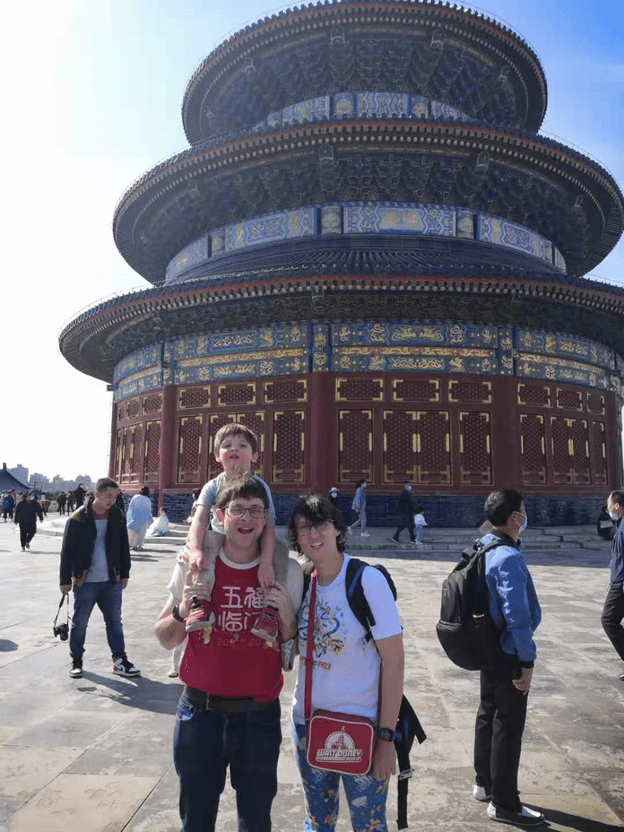
This great big temple directly south of the Forbidden City was constructed as a place of ritual sacrifice and offering to the heavens. Today it feels quite far removed from the Forbidden City, largely due to traffic and the fact that Beijing in its heyday wasn’t really a city for people to live in. Beijing like all Chinese Capital cities was more of a giant ritualistic enterprise. The Confucian scholars who made up the majority of the government loathed merchants and the whole industry of trade and their grip on China became absolute half way through the Ming Dynasty (Around the 15th century). So Beijing never really functioned as a ‘city’ in the way we think of them in the West. Sure people lived in it, many people lived in it, and there was a merchant quarter, but the cities design and drive was not around making money, it was all about administering the Empire and performing ritual. Thus this big pretty temple was built about 2 miles south of the Emperors home, and a few times per year he would leave the Forbidden City ( A rare event for most Emperors) and make offerings here on behalf of the Empire. Today it is a very lovely park, which we unfortunately really had to rush through as we had to ensure we made it to the Airport in time for our flight back to Hangzhou.
I must say I do need to take a train to Beijing soon just to try it out. I really do believe that it may be quicker or take just as long as flying when you think about the logistics of it. Hangzhou to Beijing is a four and a half hour train ride, so like going from Oshawa to Montreal. This becomes quite impressive when you consider that it’s 1300 kms between Hangzhou and Beijing by car. A flight takes about 2 and a half hours if you go direct. Now factor in the fact that you’ll want to get to the airport 2 hours early and that airports tend to be about an hour outside of the city proper compared to train stations which tend to be in the city and only require you to get to about 30-60 minutes before departure…and it starts to even up. Also the airport is about an hour from our apartment whereas the train station is 15 minutes…In addition, trains are almost never cancelled or delayed. What messes all of this up is the price and Hector. Weirdly train tickets are the same price or more expensive than a plane. In addition Hector tends to behave better on planes than buses because you can physically restrain him.
Pretty much an entire month later we had our second long weekend. Just a Friday off this time, but I figured it was enough time to go back and check the things we missed out on the last time we visited Nanjing. In 2019 we missed two major attractions. 1: The Nanjing Massacre Memorial. Or as it’s more commonly known in China: Memorial Dedicated to the Victims of Aggression of Japanese Invaders….I prefer the three word variant.

As you can see, it is a cheerful place. The other place we had actually visited before, well almost visited. Nanjing was the first major Chinese city we visited in the summer of 2019, back before we had many of the apps which make life easy in China. I had wanted to visited the Mausoleum of Sun Yat-Sen, the father of modern China. However after a struggle to actually get to the entrance of the place. (It is on top of a mountain with no taxi’s allowed to scale all the way up) We discovered that we actually needed to book tickets ahead of time. So we had to walk back down the mountain in abject defeat. Not this time however!
On the first day we visited the Nanjing Massacre Memorial. For those of you unaware, this memorial is dedicated to the 300,000 Chinese people (Mostly civilians) who were executed by the invading Japanese in 1937. For most of us in the West WW2 doesn’t really kick off until Hitler invades Poland. For the Chinese it most certainly kicked off a few years earlier when Japan invaded Shanghai and then moved onto what was then the Capital of China, Nanjing. This death toll is a bit controversial. Some people in Japan declare that it is grossly inflated and that most of the deaths were a result of surrendering Chinese soldiers being executed…because that is somehow better.
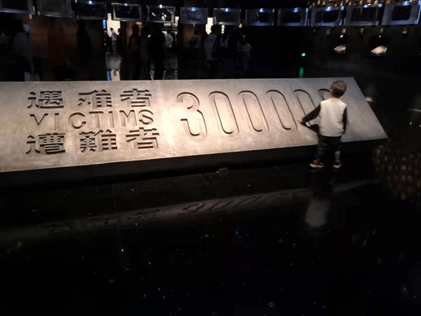
The reality is that we’ll probably never know the exact number of deaths or the number of rapes. But both are surely in the hundreds of thousands. Many corpses were simply dumped into the Yangtze river and would have drifted off into the Pacific Ocean. Many of said corpses had been violently raped before hand. What we do know is that Nanjing lost most of it’s population and that 140,000 complete skeletons in mass graves have been uncovered…so far. Unlike their German counterparts the Japanese were not as meticulous or good at record keeping when it came to their crimes, so we’ll probably never get an entirely accurate picture. The Red Cross was there at the time and kept a record of the bodies they were burying and with them we hit a number around 260,000. Once again these are the bodies they could get their hands on and hadn’t been dumped or burnt to ashes already.

Whilst big news in the late 1930s and into the 1940s in the West. By the 1950s to the mid 1990s the event was seemingly completely forgotten by the western world. That was until a Chinese American woman from New Jersey wrote a book about it. Iris Chang as photographed with me here spent much of her adult life researching the event, interviewing victims in China and eventually in 1997 published a book The Rape of Nanking which has become one of the best Western made books on the subject.
On a less depressing note, that night we visited Mai Pizza, a Canadian owned Pizza restaurant and bar near the memorial. They had very very very good Chicken wings
The next day we got up early and headed to Sun Yat-Sens’ mausoleum. Hector loved it.
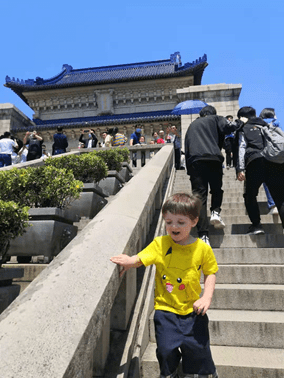
The fact that this Mausoleum exists at all is itself hilarious. You see the man interred in it, in his last moments of life begged his followers to build him no grand monument, to instead use that money to rebuild a then very broken China…3 years later his giant tomb was built. Sun Yat-Sen was a Chinese doctor who spent most of his life living in the West. He spent much of his youth in Hawaii, 12 years in total. Converted to Christianity. Got kicked out of China when he tried to start a revolution and spent 16 more years in the States and Europe, planning and leading 9 more revolutions from exile. Went back to China to become president of a modern government he had helped set up, got kicked out again and spent 4 more years in the west. Came back and 5 years later died of liver cancer. Technically speaking much of his life was defined by failure. Still he managed to lead a movement (In exile no less) which ended 2100 years of Dynastic Rule and his vision for a modernized China has since been adopted by the Chinese government. This guy envisioned in 1920 the building of 10,000 miles of rail (Check), building hydro-electric dams along the Yangtze River (Check), implementing a democratic and multi-party system of government in China. (Redacted). The fact that he was not a military man, but rather a doctor/philosopher I think gets him a lot of credence. I could blather on about this guy for thousands of words, but in short, I quite like him and really wanted to visit his tomb.
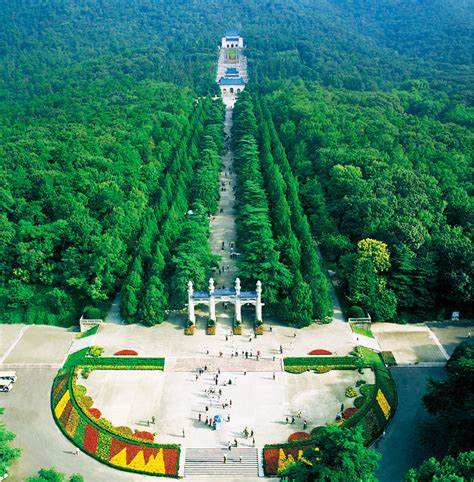
It is an interesting complex if just because it mimics a lot of aspects of traditional Chinese tomb building and then dials them up to eleven. The tomb, has also become hilariously commercialized. The image above is from the late 1990s. Today the big flat ground you see in the image is filled with KFC and VR headsets. We made our way up the steps, Hector mostly running in the right direction.
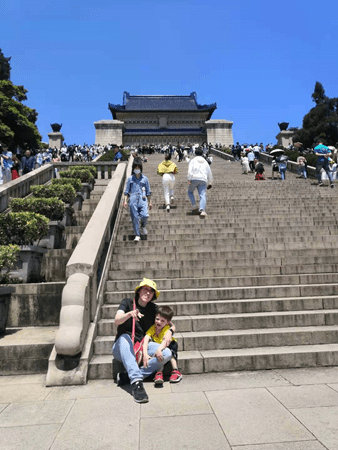
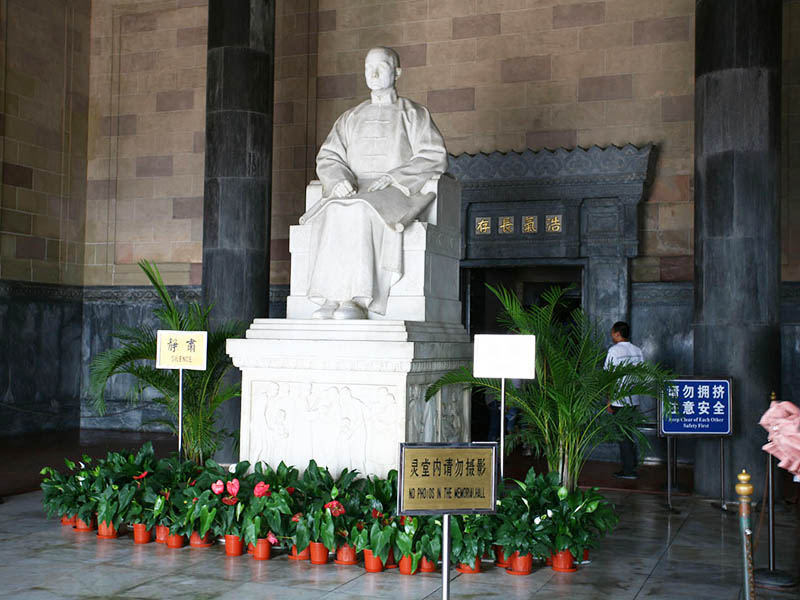
Upon reaching the tomb itself I was a bit disappointed to learn that I could not actually enter the tomb room itself. Instead you get to circle around a beautiful sculpt of Sun Yat-Sen seated atop a throne of marble.
The view from atop of the mausoleum is also quite impressive

At least Hector thought so.
So we clambered back down the mountain, got on a bus and a subway and next brought ourselves to Xuanwu Lake. Given that we live in the most famous ‘Lake’ city, you would expect us to not be all that impressed by a lake which is about 1/3rd the size in Nanjing. In actuality we were quite impressed. Whilst not as vast as West Lake, Xuanwu Lake has a lot going for it.
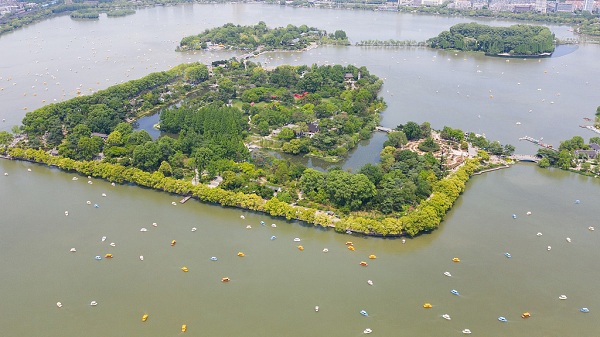
Xuanwu like many city lakes in China is a largely man made construction. The fact that they were making islands and causeways 1,500 years ago does add a certain level of impressiveness to it. The lake is largely defined by the island chain spearing through the middle of it connected by long bridges. One island even has a little theme park on it! I was struck by just how many families I saw out having picnics in the green spaces of these islands, flying kites or just sunbathing. It was a bit like Central Park or Kings Park. In Hangzhou the park is so famous and so inundated with tourists that there really isn’t space to have a picnic, here in Xuanwu there was plenty of that coveted green space.

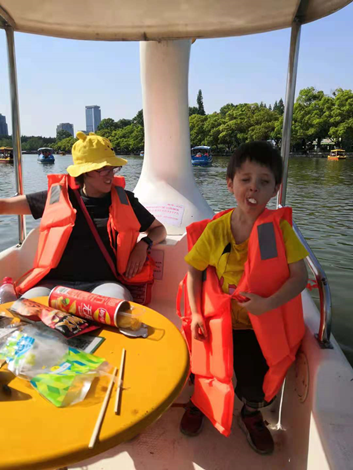
In the end we decided to rent a electric boat to have a floating picnic on. I gathered up a picnic lunch from a nearby convenience store and we took to the incredibly flaccid seas.

We certainly were not the only ones. I wish I could have taken a better aerial shot of the hundreds of little electric boats puttering around the lake. Some of them were amusingly designed to look a lot like the tourboats you often see floating around West Lake as pictured above. Ours was shaped like a swan. Hector we have learned, quite recently, seems to quite enjoy boats. Until we ran out of food he seemed quite content…even if he wouldn’t wear his life preserver properly, to be fair neither would his mother.
Afterwards we clambered up the Ming era (same guys who built much of the Great Wall) walls which enclose the old city of Nanjing.

At this point, the temperature was quite high and Hector was quite happy to express his displeasure with it.

He demanded that he be able to carry the water. The old city walls of Nanjing were built around the same time as the Mutianyu section of the Great Wall of China. Today they have been partially reconstructed having been heavily damaged during the Japanese invasion and even half-marathons take place atop of the wall!
So those are the brief notes (If you can call over 3000 words brief) on what we have been up to over the last month. This is completely ignoring the two or three times we’ve been to Disneyland, we just seem to find it difficult to stay in one place during the weekend!
Our next major break (Another 3 day weekend) is coming in June, hopefully I will be able to find the time to blog about wherever we go for that. Right now I am leaning towards Moganshan!


You certainly got a lot touring in a short period of time. I enjoyed reading it and will forward your blog on to a few friends.
LikeLike
That was an interesting read, thanks for all the detail about the places you visited and thanks for all the pics.
LikeLike